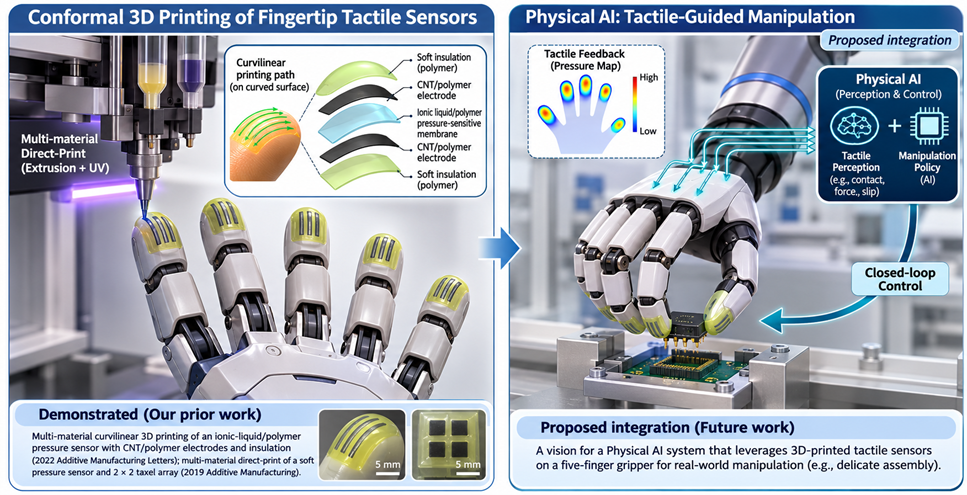
Tactile sensing is a fundamental technology that enables physical systems to perceive and understand their interactions with the surrounding environment. Unlike conventional force sensors that primarily measure the magnitude of an applied load, intelligent tactile sensing aims to extract rich information about contact forces, deformation, sliding motion, and contact conditions.
Since 2013, AAML has been developing flexible and stretchable tactile sensors, sensing materials, and sensor architectures capable of measuring complex mechanical interactions. Our research integrates materials science, contact mechanics, sensor design, advanced manufacturing, and signal interpretation to develop next-generation tactile sensing technologies.
Flexible and Stretchable Tactile Sensors
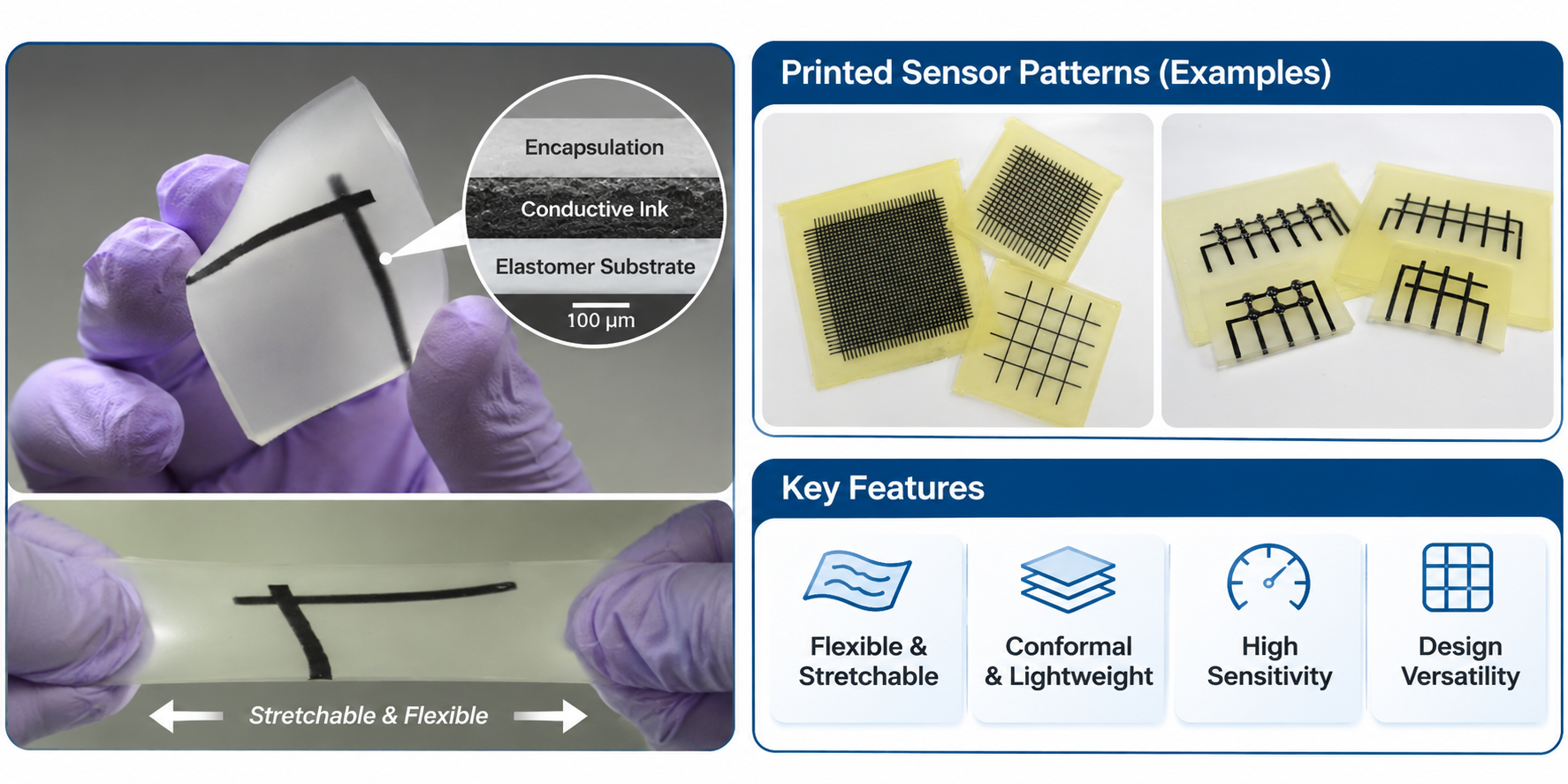
We develop soft tactile sensors that maintain their sensing capabilities under mechanical deformation. Our research explores conductive polymer composites, ionic liquid-based sensing materials, and deformable electrode architectures to achieve mechanical compliance, high sensitivity, and compatibility with curved and deformable surfaces.
Key research topics include:
- Flexible and stretchable sensing materials
- Conductive polymer nanocomposites
- Ionic liquid-based sensing mechanisms
- Deformable electrodes and sensor architectures
- Conformal integration of tactile sensors
Multi-Axis Force Sensing
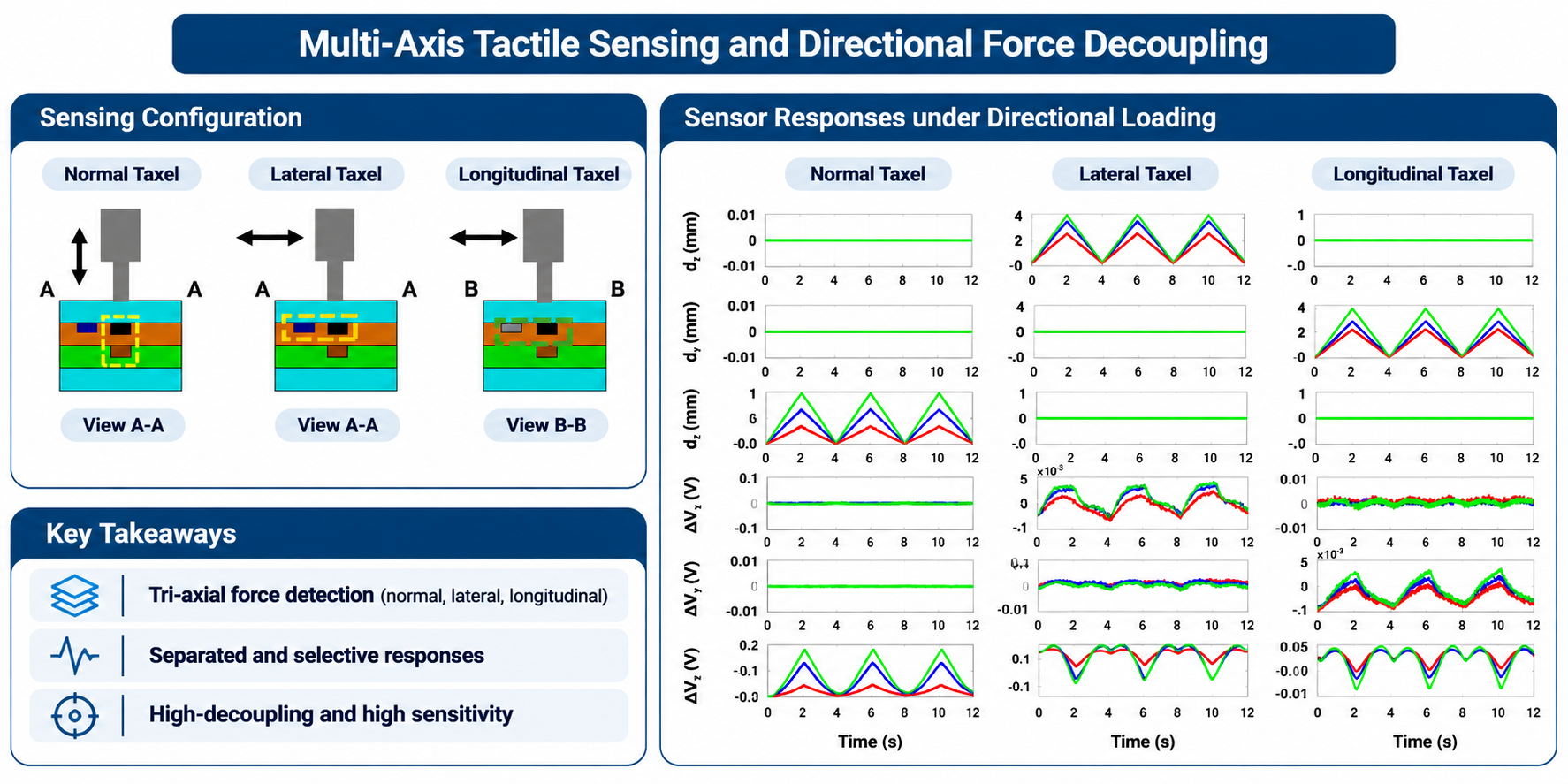
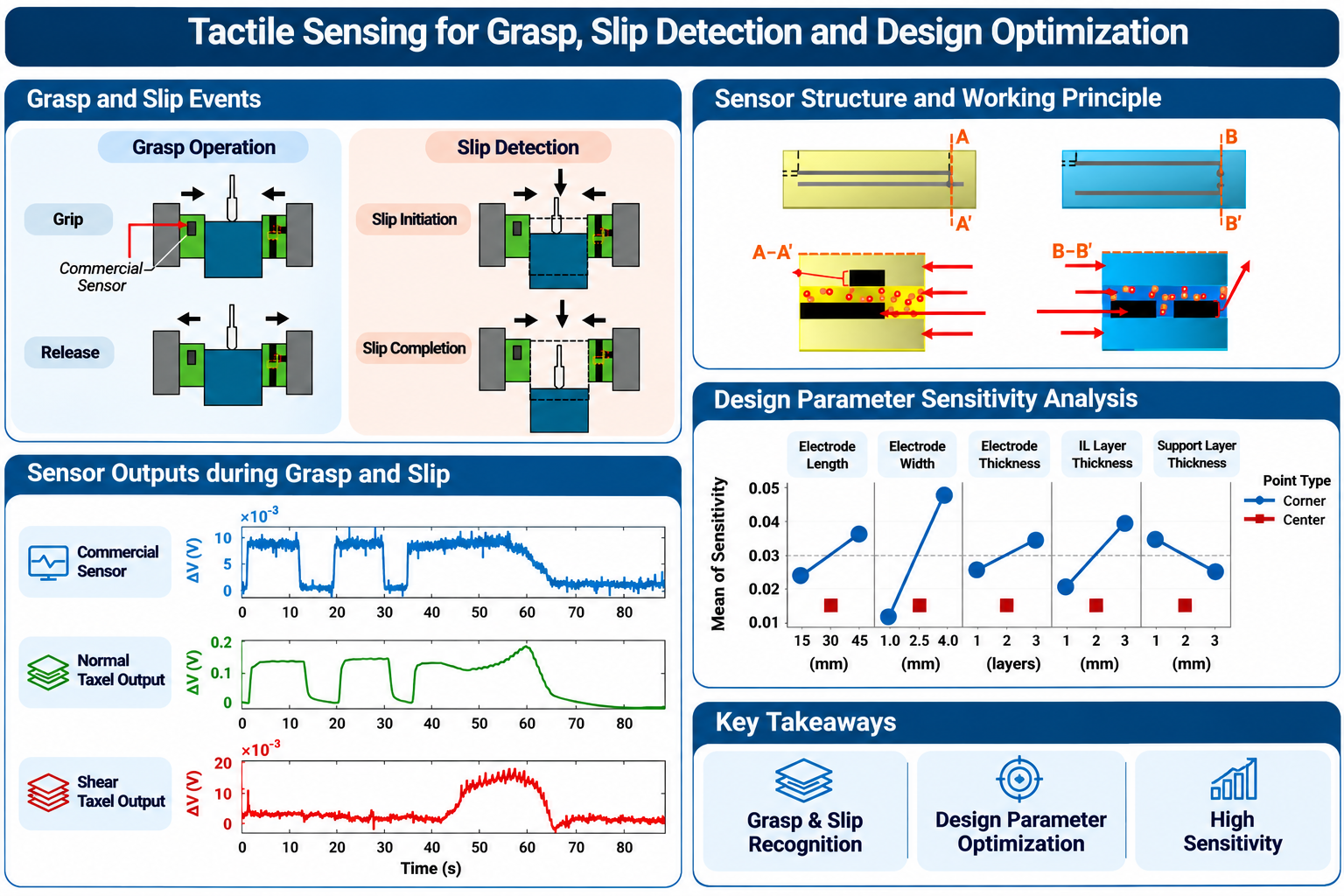
Accurate measurement of both normal and shear forces is essential for understanding physical interactions. We investigate multi-axis tactile sensors capable of distinguishing normal loading from directional shear loading.
Our research focuses on:
- Simultaneous measurement of normal and shear forces
- Directional shear force sensing
- Decoupling of multi-axis sensing responses
- Cross-talk characterization and reduction
- Effects of stretching and deformation on sensor performance
Slip Detection and Contact-State Estimation
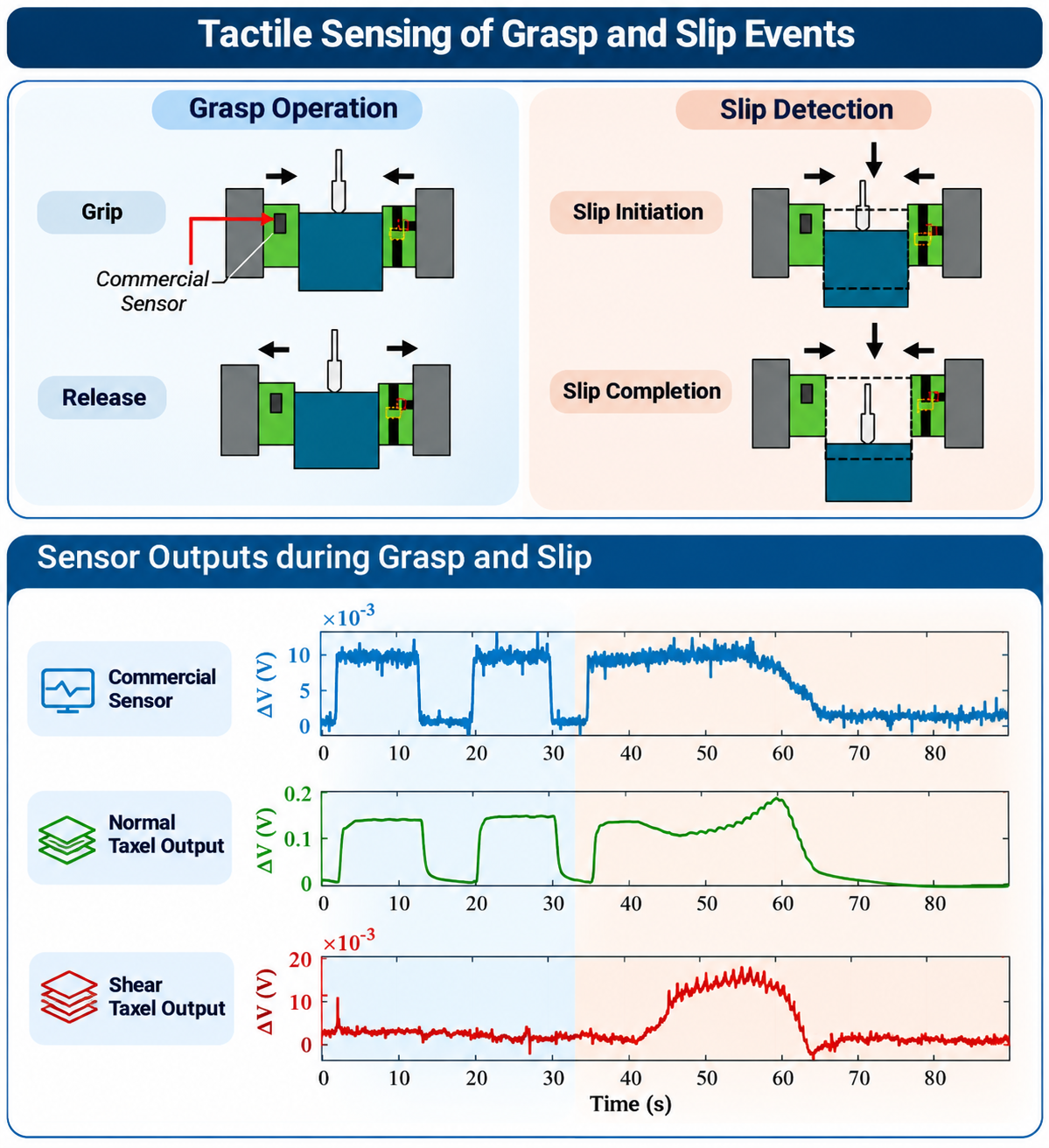
Detecting slip and understanding the relative motion between contacting surfaces are critical for stable robotic manipulation and intelligent physical interaction.
Our research investigates tactile sensing mechanisms for identifying:
- Static and sliding contact
- Slip initiation and progression
- Direction and speed of sliding motion
- Changes in contact forces
- Tactile signatures associated with physical interactions
These sensing capabilities provide a foundation for tactile-feedback-based robotic control and adaptive manipulation.
Sensor Mechanics and Performance Optimization
The performance of soft tactile sensors is strongly influenced by material properties, sensor geometry, electrode configuration, and mechanical deformation. We investigate the relationships between mechanical behavior and sensing responses through experimental characterization, modeling, and sensor design optimization.
Research topics include:
- Effects of material hardness and stiffness
- Geometry-dependent sensitivity
- Mechanical load transfer
- Sensitivity and load capacity
- Viscoelastic effects and dynamic sensing responses
- Sensor performance under complex deformation
Toward Physical AI
Our long-term research vision is to advance tactile sensing from conventional force measurement toward intelligent tactile perception. Building upon our established research in soft sensors, multi-axis force measurement, and slip detection, we are expanding our efforts toward data-driven tactile signal interpretation, multimodal sensor fusion, contact-state estimation, and adaptive physical interaction. These efforts aim to establish the physical sensing foundations necessary for next-generation robotic systems and Physical AI.